Do GLP-1s make you lose muscle?
Some of it, yes. When you lose weight quickly by any method, a meaningful share of what you lose is lean mass rather than fat. That is documented for dieting and for bariatric surgery as well as for GLP-1 medications, so it is not unique to these drugs. What protects lean mass is adequate protein, resistance training, and a sensible rate of loss.
Is this a GLP-1 problem or a weight-loss problem?
Mostly the latter. Body weight is not made of a single tissue. When you are in an energy deficit, your body draws on fat stores and, to a lesser but real degree, on lean tissue, which includes muscle along with organ mass, connective tissue, and the water they hold. This has been observed in weight-loss research for decades, long before GLP-1 medications existed.
What is fair to say about GLP-1 medications specifically is that they make eating less markedly easier, so people can lose weight faster and eat less protein along the way without noticing. The medication does not target muscle. The speed of loss and the quality of what you eat are the variables that actually move.
Exact figures for how loss splits between fat and lean mass vary by study, population, and how it was measured. Those numbers belong on our evidence pages: see the science of semaglutide and the science of tirzepatide.
What actually protects lean mass
Three things carry almost all of the weight here, and none of them are exotic:
- Enough protein, spread across the day. Appetite suppression makes it easy to under-eat protein without realizing. Many clinicians aim for roughly 1.0 to 1.5 grams of protein per kilogram of body weight per day during active weight loss; your provider should set your target, particularly if you have kidney disease.
- Resistance training, two or three times a week. Giving muscle a reason to stay is the most consistently supported way to protect it during weight loss. It does not have to be a gym; it does have to be progressive and regular.
- A sensible rate of loss. Faster is not better. A pace your provider is comfortable with gives your body less reason to break down lean tissue.
- Do not skip meals because you are not hungry. Not being hungry is the medication working. Eating nothing all day is not the goal, and it is the fastest route to under-eating protein.
- Sleep and general recovery. Unglamorous, and it matters for how well training translates into retained muscle.
How this fits into a treatment plan
Lean mass is a monitoring conversation, not a one-off. At Expert Health, compounded semaglutide starts at $199 per month ($597 for a 3-month supply) and compounded tirzepatide at $332 per month ($997 for a 3-month supply), and the check-ins exist so this is reviewed rather than assumed:
- A free consultation with a health specialist, with no obligation to buy
- A US-licensed provider who can slow your titration or hold a dose if you are losing faster than is comfortable
- Provider check-ins every four weeks, where protein intake, training, and how you feel are all fair game
- Free, discreet shipping, and pricing you see before you pay
Compounded medications are not FDA-approved. A US-licensed provider decides whether treatment is appropriate for you.
What helps, and what is oversold
| Approach | How well supported it is | Notes |
|---|---|---|
| Adequate protein intake | Well supported for preserving lean mass during weight loss | The single easiest thing to get wrong when your appetite is suppressed |
| Resistance training | Well supported | The most reliable lever you control. Two or three sessions a week is a realistic floor |
| A slower rate of weight loss | Well supported | Managed through titration pace and dose, with your provider |
| Cardio alone | Helps general health, not a lean-mass strategy | Useful, but it is not a substitute for resistance training |
| Supplements marketed as muscle-sparing | Largely unsupported for this purpose | Marketing tends to run far ahead of the evidence |
| Growth hormone peptides such as sermorelin | Not established for preventing GLP-1 associated lean mass loss | Not FDA-approved for this use. A separate treatment with its own criteria, to raise with a provider |
| Testosterone therapy | Approved only for men with hypogonadism confirmed by lab testing | Not a weight-loss or muscle-preservation treatment, and not prescribed on that basis |
General orientation, not medical advice. What is appropriate for you is a decision for a US-licensed provider who knows your history.
What about sermorelin, testosterone, and peptide stacks?
This is the most common follow-up question, and it deserves a straight answer rather than an upsell. There is no good evidence that sermorelin, testosterone, or any peptide prevents the lean mass loss that comes with rapid weight loss. Anyone telling you otherwise is ahead of the data.
What is true is that they are separate treatments with their own criteria, and some people on a GLP-1 turn out to be candidates for one of them for entirely separate reasons. Sermorelin is a growth-hormone-releasing peptide that is not FDA-approved for the uses it is commonly marketed for, and the human evidence is early. Testosterone therapy is approved for men with hypogonadism confirmed by bloodwork, and it is prescribed on the basis of symptoms plus labs, never as a physique treatment.
So the honest framing is: bring them up at your consult if you are curious, let a provider tell you whether you are a candidate on their own merits, and do not buy either one expecting it to solve muscle loss on a GLP-1. Protein and resistance training remain the answer to that question.
How to tell whether you are losing muscle
The scale cannot tell you, which is why it is a poor instrument for this. More useful signals:
- Strength trends. If the weights you lift are drifting down over weeks, that is worth raising. A small dip during a deficit is common; a steady slide is a signal.
- Body composition measurement. A DEXA scan or a comparable body composition assessment gives you fat mass and lean mass separately. Repeat it with the same method if you want a fair comparison.
- How you feel doing ordinary things. Stairs, carrying shopping, getting up from the floor.
- Protein tracking for a week. Most people who are worried about muscle loss discover they are simply eating far less protein than they assume.
- Unusual fatigue or weakness. Worth mentioning to your provider, since it can also point at dehydration or under-eating generally.
If your appetite is so suppressed that eating adequately is a struggle, that is a dosing conversation. See how to reduce GLP-1 side effects, and read what food noise is for what actually changes about eating on these medications.
Frequently asked questions
Do semaglutide and tirzepatide cause muscle loss?
Is muscle loss on a GLP-1 worse than with dieting?
How much protein should I eat on a GLP-1?
Does lifting weights prevent muscle loss on a GLP-1?
Will sermorelin or peptides stop me losing muscle on a GLP-1?
Should men on a GLP-1 consider testosterone therapy for muscle?
Does losing muscle slow your metabolism?
Is 'Ozempic face' the same as muscle loss?
Content is provided for educational purposes only and does not constitute medical advice. Mention of a medication or substance does not indicate that it is available through Expert Health. Treatment availability and eligibility are determined by licensed healthcare professionals and applicable regulations. This article is for general educational purposes and is not medical or legal advice. Statements have not been evaluated by the FDA, and treatments referenced are not intended to diagnose, treat, cure, or prevent any disease. Compounded medications are not FDA-approved. Individual results vary. Always consult a licensed provider before starting any treatment.
Explore weight-loss treatments
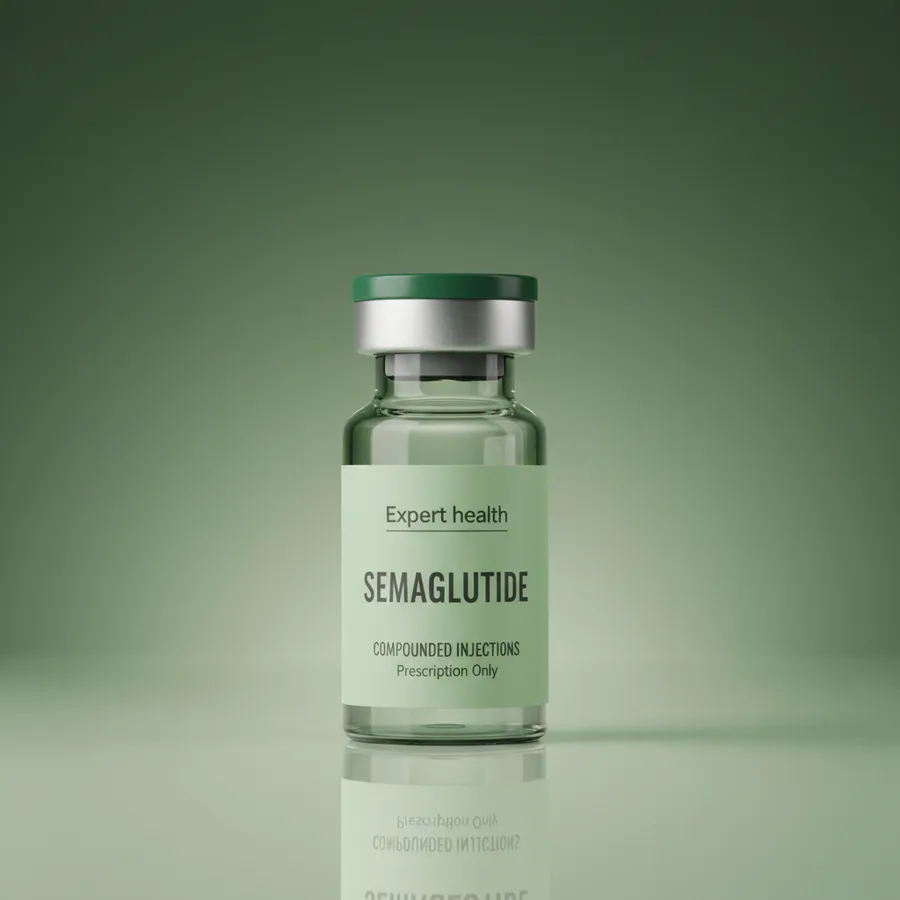
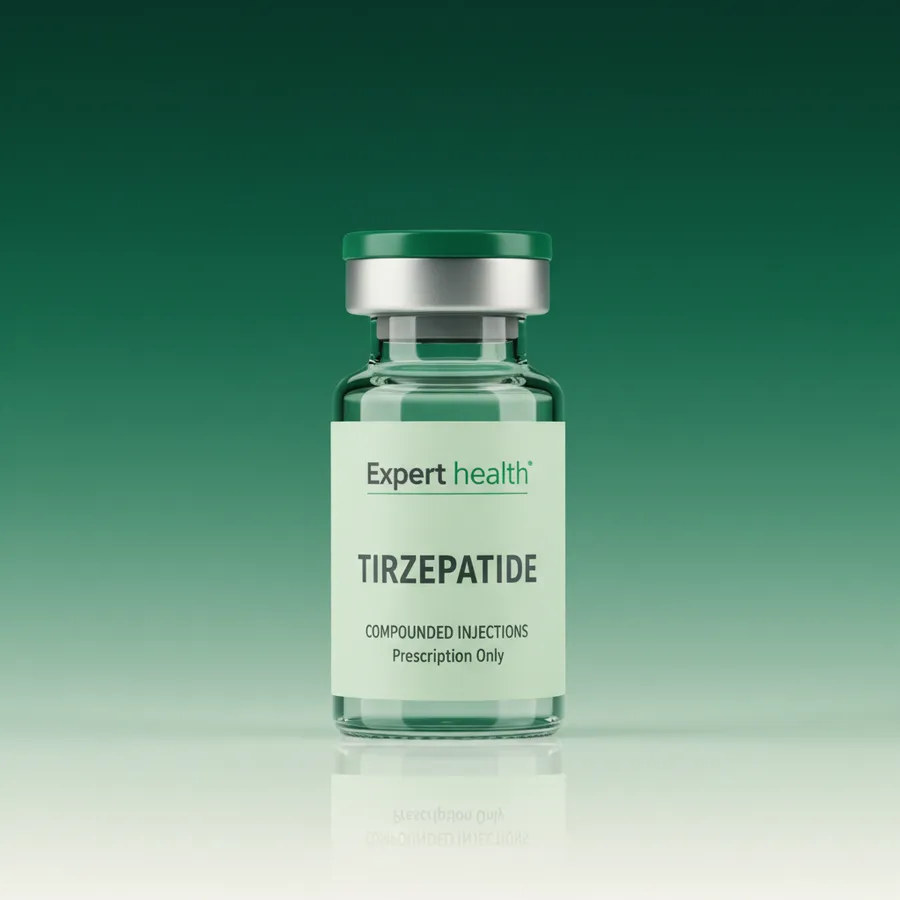
Product images are for illustrative purposes only. Actual medication vials, packaging, pharmacy labels and branding may vary. Expert Health facilitates access to care but does not compound, manufacture or dispense prescription medications. Medications are fulfilled by independent licensed pharmacies where legally permitted.
Start with Semaglutide.
As low as $199/mo. Prescribed by a US-licensed provider, compounded by a licensed US pharmacy, and shipped free to your door.
See Semaglutide and pricingNot sure it is the right fit? Speak with a health specialist, free, or browse all treatments.