How to choose an online weight loss clinic
Judge an online weight loss clinic on nine things: who prescribes, brand or compounded, whether the quoted price includes the medication, the price at your maintenance dose, insurance help, how titration is managed, muscle loss and nutrition, the plan for when you stop, and cancellation terms. The single most useful question is the third one: does that number include the drug, or is it a membership fee?
The nine criteria that actually separate these clinics
Almost every clinic in this category claims to be the best one, which makes the claim worthless. These nine are checkable from a public website before you create an account, and they are the ones that change what you pay and what happens to you.
| Criterion | What good looks like | Warning sign |
|---|---|---|
| Who prescribes | A US-licensed provider, licensed in your state, who is allowed to decline | No prescriber named, or approval that arrives the instant you pay |
| Brand or compounded | Stated plainly, with compounded described as not FDA-approved | The words 'same active ingredient as Wegovy' used to imply equivalence |
| Does the price include the medication | One all-in number covering consult, medication, shipping and follow-up | A membership fee quoted as the price, with the drug billed separately |
| Price at maintenance dose | Told to you up front, because titration raises the dose | Only the starting-dose price is published anywhere |
| Insurance help | Either real prior-authorization support, or a clear statement that they are cash pay only | Vague suggestions that insurance 'may cover it' with no process behind them |
| Titration management | A written schedule, and a provider who adjusts it when side effects hit | A fixed dose escalation with no way to slow down |
| Muscle and nutrition | Protein and resistance-training guidance built into the plan | Silence on what you lose besides fat |
| The exit plan | An honest conversation about what happens when you stop | No mention of maintenance or coming off, ever |
| Cancellation | Terms findable in a minute, and a plan you can actually stop | Auto-renewal in the footer, or cancellation only by phone |
None of these require you to trust a brand's self-description. All nine are verifiable from the public site before you spend anything.
The five kinds of provider, compared
The category looks like one market and is really five, and they differ on regulation and on what the price covers, not just on the number. Sorting the option in front of you into one of these buckets makes the comparison much easier.
| Kind of provider | What you get | How pricing usually works | Best for |
|---|---|---|---|
| Manufacturer direct (NovoCare, LillyDirect) | The FDA-approved brand product, direct from the maker | Published dose-specific self-pay pricing, no clinical membership | Anyone who wants the brand product and does not need a care wrapper |
| Large telehealth with a membership model | Provider access, ongoing support, and often insurance navigation | A monthly membership, with the medication billed separately on top | People with insurance who want help getting it approved |
| Telehealth clinics with all-in compounded plans | Compounded semaglutide or tirzepatide, consult and follow-up in one price | One published monthly or multi-month number, medication included | Cash payers with no coverage who want a single predictable bill |
| In-person or insurance-based weight clinics | Face to face care, labs on site, and billing through your plan | Copays and visit fees, subject to your deductible | Anyone with complex medical history or strong coverage |
| Research-chemical vendors | Vials labelled not for human use, with no prescriber and no pharmacy | A low sticker with nothing else attached, because nothing else exists | Nobody. This is not the same purchase at a discount |
Expert Health sits in the third row. Compounded medications are not FDA-approved. Whether that row is right for you depends mostly on your insurance, which is worth checking first.
If you want the arithmetic on the second row versus the third, we have written it out with real published figures in Expert Health vs Ro, and the full route-by-route price comparison lives in the cheapest way to get semaglutide.
How Expert Health answers its own nine criteria
Publishing a checklist and dodging it would be worth nothing, so here are our answers, including the ones that are limitations rather than selling points.
- Who prescribes. An independent, US-licensed provider reviews your intake and prescribes only if treatment is appropriate. Expert Health does not write prescriptions itself, and a provider can decline.
- Brand or compounded. Compounded. Our semaglutide and tirzepatide are prepared by state-licensed US pharmacies, and compounded medications are not FDA-approved. We do not dispense brand Wegovy, Ozempic, Mounjaro or Zepbound.
- Does the price include the medication. Yes. Semaglutide is $199 per month, $597 for a 3-month supply. Tirzepatide is $332 per month, $997 for a 3-month supply. There is no separate membership fee.
- Price at maintenance dose. Maintenance cost varies by dose, and your provider will tell you what yours looks like before you commit rather than after.
- Insurance help. None, and this is a genuine limitation. We are cash pay. Compounded medications are generally not covered, so if you have insurance that covers a brand GLP-1 you should use it instead of us.
- Titration management. Provider check-ins every four weeks, with the dose adjusted to how you are responding rather than to a fixed calendar.
- Muscle and nutrition. Covered in our guides on GLP-1 and muscle loss and what to eat on a GLP-1, and raised at check-ins.
- The exit plan. Discussed openly. See how long you take a GLP-1, which does not pretend this is a three-month purchase.
- Cancellation. Plan terms are published, and you see the full price before you pay.
Limitations, stated plainly: we do not bill insurance, we do not carry brand GLP-1s, providers are not available in every state, not every product is available in every state, and a provider may decide that no treatment here is right for you. A clinic in this category with no limitations at all is the thing to be suspicious of.
Green flags and red flags
These are the tells that show up on the homepage, before you have handed over an email address.
Green flags
- The full price is published, and it says whether the medication is in it
- Compounded products are described as not FDA-approved, without hedging
- The site says a provider can decline to prescribe
- The dispensing pharmacy is named and licensed in the US
- Titration, side effects and what to do about them are covered honestly
- There is a stated position on muscle loss and protein intake
- Someone tells you to check your insurance first, even though that loses them the sale
Red flags
- A membership price presented as the cost of treatment
- Weight loss percentages quoted at you on a commercial page
- Before-and-after photos with no context and no source
- 'No prescription needed' or 'research use only' anywhere on the site
- Countdown timers or expiring discounts on a prescription medication
- A claim that a compounded product is 'the same as' the brand
- No mention anywhere of who is allowed to say no to you
Eight questions to ask before you pay
Ask these on the consult. A clinic that answers all eight without hedging is one you can evaluate properly, whichever way you then decide.
- Does that price include the medication, or is it a membership on top of it?
- Is this brand or compounded, and if compounded, are you telling me it is not FDA-approved?
- What will I pay per month at my maintenance dose, not my starting dose?
- Which pharmacy compounds and dispenses this, and is it licensed in the US?
- Is the provider licensed in my state, and can they decline to prescribe me?
- What do you do if I get side effects and need to slow the titration down?
- What is the plan for protein and resistance training while I am losing weight?
- What happens when I want to stop, and how do I cancel?
For the version of this checklist that covers peptides and hormone therapy rather than weight specifically, see how to choose an online peptide clinic. To run the checklist against us, see is Expert Health legit.
So which online weight loss clinic is best?
There is no single best one, and any site that names itself the answer is telling you about its marketing budget rather than its care. The right clinic is the one that is licensed in your state, works with the medication that fits your situation, prices it in a way you can actually compare, and monitors you while you are on it.
The practical version: check your insurance first, because coverage beats every cash price including ours. If you are paying cash, compare all-in numbers rather than stickers, and ask what happens at the maintenance dose. If you want to talk it through before deciding, a free call with a health specialist costs nothing and does not commit you to anything. Book the call here.
Frequently asked questions
How do I choose an online weight loss clinic?
What is the most important question to ask a weight loss clinic?
Which online weight loss clinic is cheapest?
Should a weight loss clinic require lab work?
Is compounded semaglutide from a telehealth clinic legitimate?
What is a fair price for an online weight loss program?
Can an online clinic refuse to prescribe me a GLP-1?
Do I need to keep taking a GLP-1 forever?
Content is provided for educational purposes only and does not constitute medical advice. Mention of a medication or substance does not indicate that it is available through Expert Health. Treatment availability and eligibility are determined by licensed healthcare professionals and applicable regulations. This article is for general educational purposes and is not medical or legal advice. Statements have not been evaluated by the FDA, and treatments referenced are not intended to diagnose, treat, cure, or prevent any disease. Compounded medications are not FDA-approved. Individual results vary. Always consult a licensed provider before starting any treatment.
Explore weight-loss treatments

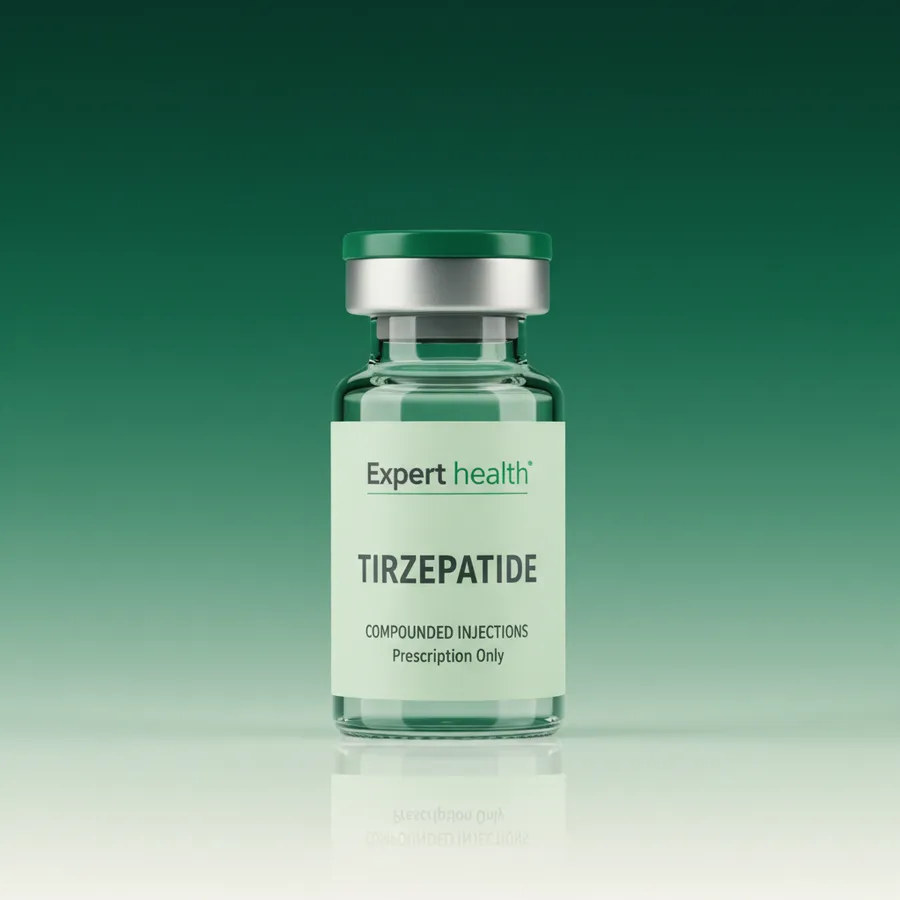
Product images are for illustrative purposes only. Actual medication vials, packaging, pharmacy labels and branding may vary. Expert Health facilitates access to care but does not compound, manufacture or dispense prescription medications. Medications are fulfilled by independent licensed pharmacies where legally permitted.
Start with Semaglutide.
As low as $199/mo. Prescribed by a US-licensed provider, compounded by a licensed US pharmacy, and shipped free to your door.
See Semaglutide and pricingNot sure it is the right fit? Speak with a health specialist, free, or browse all treatments.