NAD+ for women: what it can and cannot do
NAD+ precursors reliably raise blood NAD+ levels in humans. What rigorous randomized trials have largely failed to show is that raising them improves energy, cognition or aging outcomes, and there is no human lifespan evidence. For women in midlife the line that matters most: NAD+ is not hormone therapy, does not do what hormone therapy does, and is not a reason to decline it.
Why women in midlife ask about NAD+
Three reasons, and all three are reasonable places to start from:
- Energy and focus. Fatigue and brain fog are among the most disruptive parts of the forties and fifties, and NAD+ is marketed almost entirely on energy language, because the molecule genuinely does sit at the center of how cells make energy.
- Cellular aging. NAD+ levels decline with age, and the molecule is involved in DNA repair signalling, which is the basis of the whole longevity story that has been built around it.
- Skin. NAD+ turns up in skincare marketing, and a related form of vitamin B3 has a real history in dermatology, which makes the claim sound better documented than it is.
What follows is what is actually known about each of those, which is less than the marketing implies. That is an odd thing for a clinic to publish about a product it sells, and it is deliberate.
What NAD+ actually is
NAD+ is a coenzyme found in every cell in your body. It carries electrons through the reactions that turn food into usable energy, and it is consumed by enzymes such as sirtuins and PARPs that are involved in repair signalling. Levels decline with age, which is the observation the entire category is built on. NR and NMN are precursors, building blocks your body converts into NAD+, and they are sold as supplements. Injectable NAD+ is the coenzyme itself, prepared by a compounding pharmacy on a prescription. The molecule differences are covered in NAD+ vs NMN vs NR, and the delivery differences in injections vs IV vs oral.
Injectable NAD+ is compounded and prescribed off-label for energy and longevity goals. Compounded medications are not FDA-approved, and the FDA does not review them for safety, effectiveness or quality before they are dispensed.
What the evidence supports, and what it does not
Split the claims apart, because the true one gets used to sell all the others. Raising NAD+ is achievable and well documented. Turning that into something you feel is what has not been demonstrated.
| The claim you will see | What human evidence actually shows |
|---|---|
| It raises your NAD+ levels | Supported. Randomized trials show oral NR and NMN raise blood NAD+, often within a couple of weeks, and a head-to-head trial found both roughly doubled circulating NAD+ over 14 days. This is the best documented thing in the category |
| It restores midlife energy | Not established. A 2025 randomized trial of nicotinamide riboside raised participants' NAD+ several-fold and did not separate from placebo on fatigue, sleep or mood |
| It clears brain fog | Not established. That same trial missed its primary cognitive endpoint |
| It slows aging or extends lifespan | No human evidence. Lifespan findings come from animal models and have not been reproduced as human outcomes. Anyone claiming otherwise is selling something |
| It improves how your skin looks | Not established for NAD+ therapy. The strong dermatology result in this family is a phase 3 trial of oral nicotinamide reducing new non-melanoma skin cancers in high-risk patients, which is a different molecule, a different dose and a different endpoint entirely |
| It improves physical performance | Not established. A systematic review of NMN trials found performance changes that were not statistically significant |
NAD+ is not FDA-approved for energy, cognition, skin or longevity. Nothing in this table is a statement about what NAD+ will do for you.
The mechanism is real. The clinical outcome evidence is thin, mixed, and in several rigorous trials negative. If a clinic quotes you a percentage of women who felt better on NAD+, ask which trial it came from. The full research picture is on the science of NAD+.
NAD+ is not hormone therapy, and that distinction matters
This is the most important paragraph on the page. NAD+ is a coenzyme, not a hormone. It contains no estrogen and no progesterone, it does not act on estrogen receptors, and it has not been studied as a treatment for hot flashes, night sweats, vaginal dryness, bone loss or any other feature of the menopause transition. It does not do what hormone therapy does.
It gets marketed to women in midlife anyway, sometimes as a natural alternative to hormone therapy. It is not an alternative to it, because it is not addressing the same biology. If you are weighing up hormone therapy, weigh it up with your own clinician or a clinician with menopause training, on its own evidence and your own history. Do not let a page about a coenzyme, including this one, tip that decision.
Expert Health does not provide menopausal hormone therapy. We have nothing to gain from you choosing it or not choosing it, which is exactly why we would rather say plainly that nothing we sell is a substitute for it.
Pregnancy, fertility, and who should not take NAD+
If you are pregnant, breastfeeding or trying to conceive, the answer is to avoid it. There are no adequate controlled trials of injectable NAD+ in pregnancy or lactation, so nobody can tell you it is safe, and a compounded product with no approved label is the wrong place to accept that uncertainty. Tell your provider if any of this applies, and expect the answer to be to wait.
- Pregnancy, breastfeeding, or actively trying to conceive. Insufficient data, so the reasonable position is to avoid it.
- Active cancer, or a recent cancer history. Genuinely unresolved, and a decision for your oncologist rather than a telehealth checkout.
- Known allergy or reaction to NAD+, to preservatives in a compounded vial, or to a previous infusion.
- Significant kidney or liver disease. Anything that changes how you clear compounds needs provider review first.
- Diabetes or impaired glucose control. A meta-analysis of NAD+ precursor trials reported higher plasma glucose alongside changes in lipid markers, so flag it.
- Anyone under 18, and anyone whose history has not been reviewed by a licensed provider.
The common side effects are largely rate-related, meaning flushing, nausea and chest tightness when a dose goes in too fast, and they usually ease when it goes in slower. The full picture, including the unresolved cancer question, is in is NAD+ safe? side effects and who should avoid it.
If you decide to try it anyway
There is a defensible reason to try something unproven, which is that you have decided the mechanism is worth a shot and you would rather do it with oversight than on your own. There is also an indefensible one, which is expecting the result the marketing promised. Go in with the first.
Expert Health prices NAD+ at $249 per month on the subscription, or $675 one time for a bottle covering about a 10-week supply. What that includes:
- A free call with a health specialist, with no obligation to buy
- A US-licensed provider who reviews your history and goals, and who can decline to prescribe
- NAD+ compounded by a licensed US pharmacy and prescribed for you
- Free, discreet shipping with everything you need to inject at home
- Provider check-ins so the dose and frequency match how you actually respond
- An honest conversation about stopping if a fair trial does nothing for you
Do not start NAD+ instead of getting fatigue investigated. If sleep, iron, thyroid and mood have not been looked at, that is the higher-value step, and it is set out in perimenopause fatigue and brain fog. Compounded medications are not FDA-approved.
Frequently asked questions
Is NAD+ good for women in menopause?
Is NAD+ a form of hormone therapy?
Does NAD+ help with menopause fatigue and brain fog?
Does NAD+ help skin or slow aging?
Can I take NAD+ while trying to get pregnant?
Do NAD+ injections work better than NMN or NR capsules for women?
How much does NAD+ cost at Expert Health?
Should I take NAD+ instead of seeing my doctor about perimenopause?
Sources
- Effects of nicotinamide riboside on NAD+ levels, cognition, and symptom recovery in long-COVID: a randomized controlled trial · eClinicalMedicine, via PubMed, 2025
- Chronic nicotinamide riboside supplementation is well-tolerated and elevates NAD+ in healthy middle-aged and older adults · Nature Communications, via NIH PMC, 2018
- The differential impact of three different NAD+ boosters on circulatory NAD and microbial metabolism in humans · Nature Metabolism, via PubMed, 2025
- Physical performance parameters in patients taking nicotinamide mononucleotide: a systematic review of randomized controlled trials · Cureus, via NIH PMC, 2024
- A phase 3 randomized trial of nicotinamide for skin-cancer chemoprevention · New England Journal of Medicine, via PubMed, 2015
Content is provided for educational purposes only and does not constitute medical advice. Mention of a medication or substance does not indicate that it is available through Expert Health. Treatment availability and eligibility are determined by licensed healthcare professionals and applicable regulations. This article is for general educational purposes and is not medical or legal advice. Statements have not been evaluated by the FDA, and treatments referenced are not intended to diagnose, treat, cure, or prevent any disease. Compounded medications are not FDA-approved. Individual results vary. Always consult a licensed provider before starting any treatment.
Explore longevity treatments
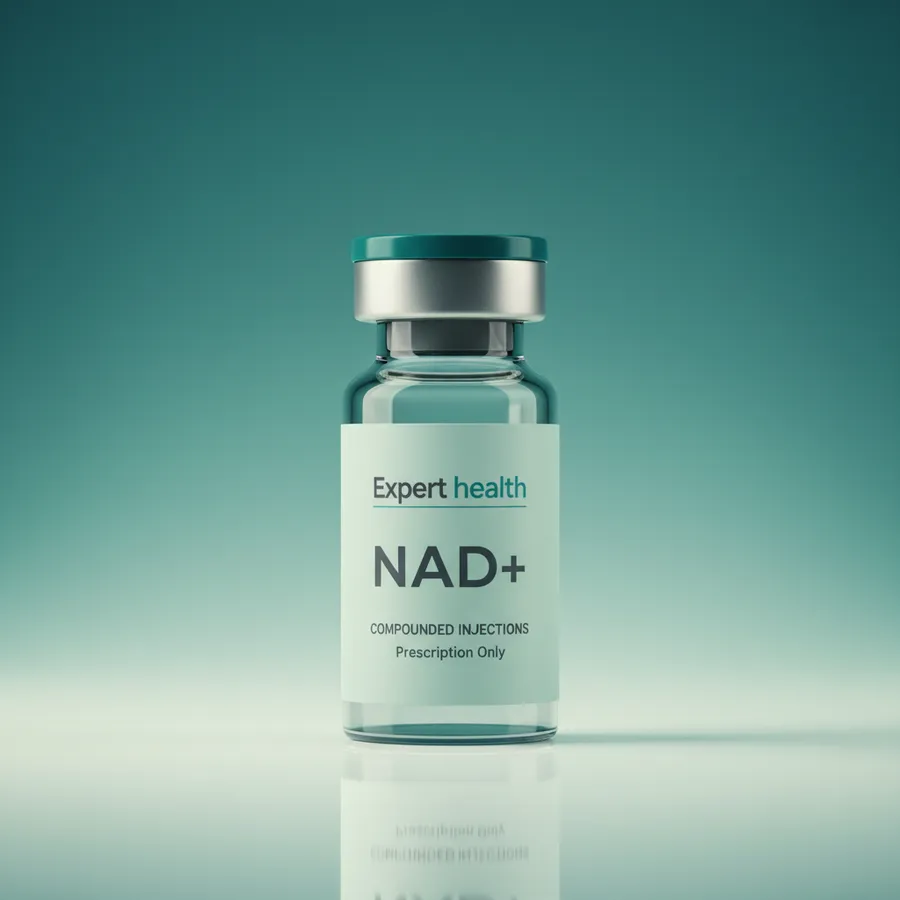
Product images are for illustrative purposes only. Actual medication vials, packaging, pharmacy labels and branding may vary. Expert Health facilitates access to care but does not compound, manufacture or dispense prescription medications. Medications are fulfilled by independent licensed pharmacies where legally permitted.
Start with NAD+.
As low as $249/mo. Prescribed by a US-licensed provider, compounded by a licensed US pharmacy, and shipped free to your door.
See NAD+ and pricingNot sure it is the right fit? Speak with a health specialist, free, or browse all treatments.