Is NAD+ safe? Side effects and who should avoid it
NAD+ and its precursors have been generally well tolerated in human trials to date. The most common problems are rate-related: flushing, nausea, chest tightness or a wave of anxiety when a dose goes in fast, and they usually ease when it goes in slower. Injection-site redness is also common. Pregnancy, breastfeeding and active cancer are physician decisions, and the long-term safety data are limited.
What people actually report
In the randomized trials run so far, NAD+ precursors have been well tolerated, with no serious adverse effects attributed to them across the participants studied. Most of what people experience with injections and infusions is tied to how quickly the dose enters the body rather than to the molecule being harmful.
| Effect | How common | What usually helps |
|---|---|---|
| Flushing, warmth or redness in the face | Common when a dose goes in quickly | Push the injection more slowly, or ask your provider about a smaller starting dose |
| Nausea or stomach discomfort | Common with larger or faster doses | Slower administration, lower starting dose, dose after food |
| Chest tightness or a wave of anxiety | Reported mainly with rapid infusion | Stop, slow the rate right down, and tell your provider before the next dose |
| Injection-site redness, itching or a small lump | Common with subcutaneous dosing | Rotate sites, let the vial reach room temperature, use clean technique and a fresh needle |
| Headache, lightheadedness or fatigue | Less common | Hydration, and a dose review with your provider |
Not a complete list. Injectable NAD+ is compounded and has no FDA-approved label, so there is no official adverse-event table for it. Report anything unexpected, and anything severe, to your provider or seek urgent care.
Why NAD+ causes flushing, nausea and chest tightness
This is the single most common complaint, and it is largely a speed problem. When NAD+ enters the bloodstream faster than the body processes it, people report a hot flush, a churning stomach and sometimes a tight chest or a jolt of anxiety. Slow the rate and those effects usually shrink or disappear. It is exactly why IV clinics run the drip over hours rather than minutes.
- Push a subcutaneous injection slowly, over half a minute or more, rather than quickly.
- Start at the low end of the dose your provider sets and move up only if it is comfortable.
- If a wave of chest tightness or anxiety arrives, that is your signal to go slower next time, and to tell your provider.
- Severe chest pain, difficulty breathing, or a reaction that does not settle is not a normal side effect. Seek urgent medical care.
The practical technique for avoiding all of this is in the NAD+ dosing guide.
Who should not take NAD+
Because injectable NAD+ has no approved label, there is no official contraindication list, which is itself a reason to have a provider make the call rather than a checkout page. The situations where the answer is no, or not without a conversation:
- Pregnancy and breastfeeding. There is not enough data to establish safety. The reasonable position is to avoid NAD+ therapy while pregnant, trying to conceive or breastfeeding.
- Active cancer, or a recent cancer history. Unresolved question, covered below. This is a decision for your oncologist, not a telehealth checkout.
- Known allergy or reaction to NAD+, to the preservatives in a compounded vial, or to a previous infusion.
- Significant kidney or liver disease. Anything that changes how you clear compounds needs provider review first.
- Diabetes or impaired glucose control. A meta-analysis of NAD+ precursor trials found improvements in lipid markers alongside higher plasma glucose, with much of the effect driven by nicotinic acid. Worth flagging to your provider.
- Anyone under 18, and anyone who has not had their history reviewed by a licensed provider.
Expert Health starts every NAD+ plan with a free call with a health specialist who can decline to prescribe. That is the point of the consult, not a formality.
On pregnancy and breastfeeding specifically, the short answer is avoid it. NAD+ biology in pregnancy is an active research area, and some of it is genuinely interesting, but interesting research is not the same as safety data in pregnant humans. There are no adequate controlled trials of injectable NAD+ in pregnancy or lactation, so nobody can tell you it is safe, and a compounded product with no approved label is the wrong place to accept uncertainty. If you are pregnant, breastfeeding or actively trying to conceive, tell your provider before starting anything, and expect the answer to be to wait.
Medication interactions and existing conditions
There is no well-mapped interaction profile for injectable NAD+, which is a statement about how little formal study it has had rather than a clean bill of health. The safe approach is to give your provider a full list, including supplements, and to raise these in particular:
- Diabetes medications. Because some NAD+ precursor trials showed higher plasma glucose, anyone monitoring blood sugar should discuss it.
- Blood pressure medication. Flushing and vasodilation on top of antihypertensives is worth a conversation.
- Chemotherapy or immunotherapy. Coordinate with your oncology team, always.
- Other supplements in the same family. Stacking a high-dose oral precursor on top of prescribed NAD+ is a decision for your provider, not a bonus.
- Peptides and hormone therapy. If you are on TRT or peptide therapy, your provider should be looking at the whole plan together rather than one product at a time.
Can NAD+ cause or accelerate cancer?
This question deserves a straight answer, and the straight answer is that it is unresolved. We are not going to reassure you and we are not going to scare you.
The concern comes from cell biology. Cancer cells are metabolically hungry, and NAD+ is central to metabolism and to DNA repair machinery, so raising NAD+ availability could in principle support cells you would rather not support. Animal work has produced signals in that direction, including reports of increased metastasis in mouse models given a precursor.
The evidence pointing the other way is real too. In a large phase 3 randomized trial, oral nicotinamide, a related vitamin B3 form, reduced new non-melanoma skin cancers in patients with a history of them, which is not what a cancer-promoting compound would be expected to do.
What does not exist is human evidence that NAD+ therapy causes cancer, and what also does not exist is human evidence that it is safe in people with active malignancy. That is why active or recent cancer is a physician-gated decision, made with your oncologist, and why we would rather turn away a sale than pretend the question is settled.
Purity, sterility and third-party testing
For an injectable, where the product came from matters as much as the molecule. A compounded NAD+ vial should come from a licensed US pharmacy that compounds sterile preparations under real standards, with a beyond-use date on the label and instructions for storage. The FDA does not approve compounded drugs, which is exactly why the pharmacy behind yours matters.
Good signs
- A licensed US pharmacy named or verifiable
- A labelled vial with concentration, beyond-use date and storage instructions
- Testing for potency and sterility available on request
- A prescription written by a US-licensed provider after reviewing your history
Warning signs
- Vials sold as 'research use only' or 'not for human use'
- No pharmacy named, or unclear overseas sourcing
- No prescription anywhere in the purchase
- Unlabelled vials, or no storage or beyond-use information
See where to get NAD+ injections online for how to vet a seller properly.
Frequently asked questions
Is NAD+ safe?
What are the side effects of NAD+ injections?
Why does NAD+ make my chest feel tight?
Who should not take NAD+?
Is NAD+ safe during pregnancy or breastfeeding?
Can NAD+ cause cancer?
Does NAD+ interact with my medications?
Is NAD+ tested for purity?
Sources
- Chronic nicotinamide riboside supplementation is well-tolerated and elevates NAD+ in healthy middle-aged and older adults · Nature Communications, via NIH PMC, 2018
- Physical performance parameters in patients taking nicotinamide mononucleotide: a systematic review of randomized controlled trials · Cureus, via NIH PMC, 2024
- Effects of NAD+ precursor supplementation on glucose and lipid metabolism in humans: a meta-analysis · Nutrition and Metabolism, via NIH PMC, 2022
- A phase 3 randomized trial of nicotinamide for skin-cancer chemoprevention · New England Journal of Medicine, via PubMed, 2015
- Compounding and the FDA: questions and answers · U.S. Food and Drug Administration
Content is provided for educational purposes only and does not constitute medical advice. Mention of a medication or substance does not indicate that it is available through Expert Health. Treatment availability and eligibility are determined by licensed healthcare professionals and applicable regulations. This article is for general educational purposes and is not medical or legal advice. Statements have not been evaluated by the FDA, and treatments referenced are not intended to diagnose, treat, cure, or prevent any disease. Compounded medications are not FDA-approved. Individual results vary. Always consult a licensed provider before starting any treatment.
Explore longevity treatments
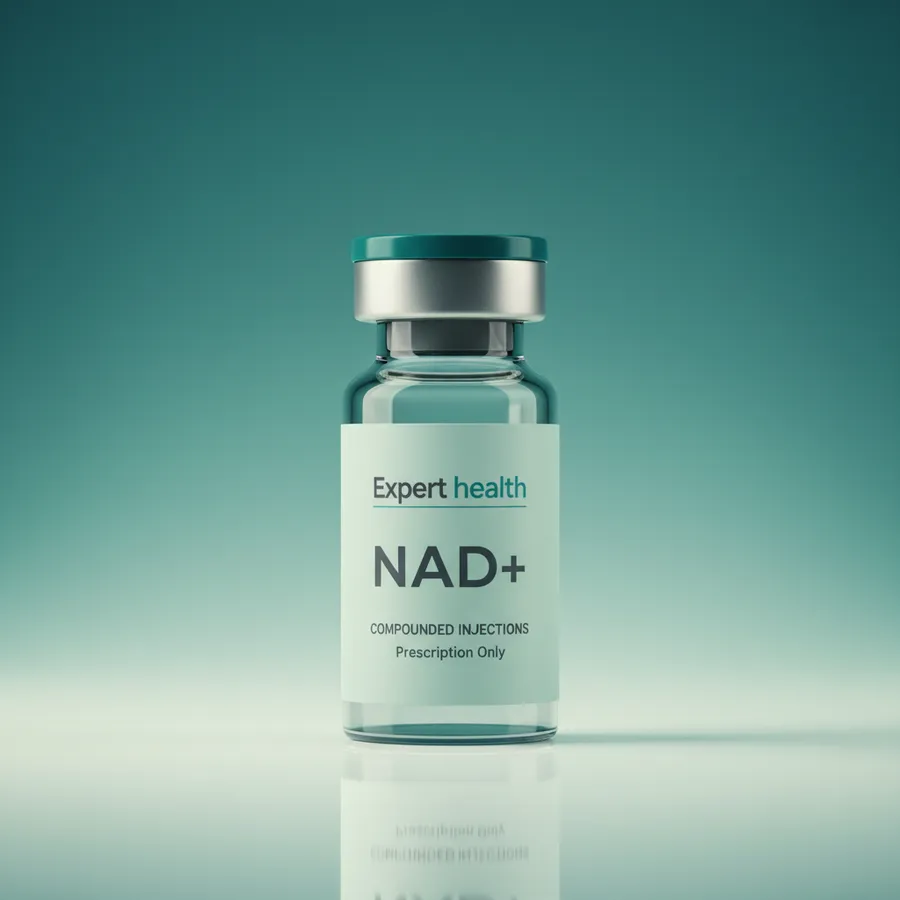
Product images are for illustrative purposes only. Actual medication vials, packaging, pharmacy labels and branding may vary. Expert Health facilitates access to care but does not compound, manufacture or dispense prescription medications. Medications are fulfilled by independent licensed pharmacies where legally permitted.
Start with NAD+.
As low as $249/mo. Prescribed by a US-licensed provider, compounded by a licensed US pharmacy, and shipped free to your door.
See NAD+ and pricingNot sure it is the right fit? Speak with a health specialist, free, or browse all treatments.