Sermorelin vs tesamorelin: which one is right for you?
Both are growth-hormone-releasing hormone analogues that prompt your pituitary to release growth hormone. The real difference is regulatory. Tesamorelin is FDA-approved for one use only, reducing excess abdominal fat in people with HIV-associated lipodystrophy, and every other use is off-label. Sermorelin has no FDA-approved use and is compounded. At Expert Health sermorelin is $199 per month and tesamorelin $332.
Sermorelin vs tesamorelin, side by side
The two are cousins. Both are analogues of growth-hormone-releasing hormone, and both work upstream by asking the pituitary to release growth hormone rather than replacing it. Where they part company is what they have been studied and approved for, how they are dosed, and what they cost.
| Sermorelin | Tesamorelin | |
|---|---|---|
| Mechanism | GHRH analogue, prompts your pituitary to release growth hormone | GHRH analogue, same upstream mechanism, with a modification that makes it more stable |
| FDA-approved use | None currently marketed in the US. Compounded on a prescription | Reduction of excess abdominal fat in adults with HIV-associated lipodystrophy, and nothing else |
| Any other use | Prescribed at a licensed provider's discretion, not FDA-approved | Off-label. Not FDA-approved for weight, muscle, longevity, or general fat loss |
| Evidence base | Early and small. Mechanism is clear, long-term outcome data in healthy adults are limited | Randomised trial data, but conducted in the HIV lipodystrophy population it is approved for |
| Dosing | Nightly subcutaneous injection, dose set by your provider | Daily subcutaneous injection, dose set by your provider |
| Cost at Expert Health | $199 per month, or $597 for about a 10-week supply | $332 per month, or $997 for about a 10-week supply |
| Usually considered for | General growth-hormone support, as a first, lower-cost step | Discussed when a provider judges the off-label profile is worth it for a specific case |
Compounded medications are not FDA-approved. Tesamorelin's approval covers HIV-associated lipodystrophy only. Any other use is off-label, and no benefit for those uses is claimed or established here.
Why 'FDA-approved' matters more than it sounds here
Tesamorelin is often marketed as the stronger option because it has real randomised trial data behind it. That data is real, and it matters, but it comes with a boundary that is usually left off the marketing. The trials were run in adults living with HIV who had excess visceral fat from lipodystrophy, and that is the population the FDA approval covers. Results in that population do not automatically transfer to a healthy adult who wants to lose belly fat.
So the accurate framing is this. If you do not have HIV-associated lipodystrophy, tesamorelin is being used off-label. Off-label prescribing is legal and common when a licensed provider judges it appropriate, but it means the benefit has not been established for your situation, and it should be discussed as an informed decision rather than sold as a proven outcome.
Sermorelin sits differently. It has no approved indication at all, and its evidence base is early and built on small studies. It is not a weaker version of tesamorelin with the same proof, and it is not a proven treatment for anything we market it for. What it is, is a lower-cost, gentler-profile prescription option that a provider can consider for general growth-hormone support.
Neither medication is FDA-approved for muscle building, longevity, or general weight loss. Anyone telling you otherwise is not reading the labels.
How to actually choose between them
The decision is rarely 'which is better'. It is 'which fits your situation, your budget, and your tolerance for using a medication off-label'. Concrete criteria a provider will work through with you:
- Do you have a diagnosed condition tesamorelin is approved for? If you are living with HIV and have been told you have lipodystrophy, that is a specific medical conversation, and tesamorelin is the on-label option. Bring it to your HIV care team.
- How comfortable are you with off-label use? If the honest answer is 'not very', sermorelin is the simpler starting point, since it is cheaper and lower commitment.
- What is your budget over a full course? $199 versus $332 per month is a meaningful gap over six months, and neither is covered by insurance for these purposes.
- How do you respond to the first course? Many providers start with sermorelin, review after a couple of months, and only revisit alternatives if there is a reason to.
- What else is going on? If your goal is really weight loss, a GLP-1 conversation may fit better than either peptide. If it is really low testosterone, that is a lab-driven conversation. Neither peptide substitutes for those.
- Are you tested in sport? Both are prohibited under the World Anti-Doping Agency list, so neither is an option for a tested athlete.
What each plan includes at Expert Health
Both plans are priced all-in rather than as a medication-only sticker. Sermorelin is $199 per month ($597 for about a 10-week supply). Tesamorelin is $332 per month ($997 for about a 10-week supply).
- A free call with a health specialist, with no obligation to buy
- The medication compounded by a licensed US pharmacy and prescribed for you
- Free, discreet shipping to your door
- Provider check-ins, so the plan is adjusted to how you actually respond
- A clear explanation of what is on-label, what is off-label, and what is not established
A provider has to agree treatment is appropriate before anything ships, and will say no when it is not. Compounded medications are not FDA-approved.
Side effects and monitoring
Because they share a mechanism, the practical monitoring is similar. Providers commonly check IGF-1 and blood glucose where indicated, since raising growth hormone can affect blood sugar handling. Injection-site reactions are the most frequently reported complaint with both. Tesamorelin's labelling also flags fluid retention and joint discomfort, and it is contraindicated in pregnancy and in active malignancy.
Tell your provider about any history of cancer, diabetes or prediabetes, pituitary disease, or pregnancy plans before starting either one. For the underlying research, see the science of sermorelin and the science of tesamorelin.
The bottom line
If you want the shortest honest version: tesamorelin has better trial data, but that data belongs to a population most readers are not in, so for most people it is an off-label option at a higher price. Sermorelin has a thinner evidence base and no approved use, but it is cheaper, gentler, and the more common starting point. Neither is a proven answer to aging, and a provider who tells you otherwise is overselling.
Compare full pricing on sermorelin cost and tesamorelin cost, or start with a free call and let a provider read your history first.
Frequently asked questions
Is tesamorelin stronger than sermorelin?
Which should I start with, sermorelin or tesamorelin?
Is tesamorelin FDA approved for weight loss?
What is the cost difference?
Can you take sermorelin and tesamorelin together?
Do they work the same way?
What about CJC-1295 with ipamorelin?
Does insurance cover either one?
Sources
- EGRIFTA SV (tesamorelin) for injection, full prescribing information · DailyMed, US National Library of Medicine
- The Safety and Efficacy of Growth Hormone Secretagogues (Sigalos & Pastuszak) · US National Library of Medicine, PubMed Central
Content is provided for educational purposes only and does not constitute medical advice. Mention of a medication or substance does not indicate that it is available through Expert Health. Treatment availability and eligibility are determined by licensed healthcare professionals and applicable regulations. This article is for general educational purposes and is not medical or legal advice. Statements have not been evaluated by the FDA, and treatments referenced are not intended to diagnose, treat, cure, or prevent any disease. Compounded medications are not FDA-approved. Individual results vary. Always consult a licensed provider before starting any treatment.
Explore growth-hormone & testosterone treatments
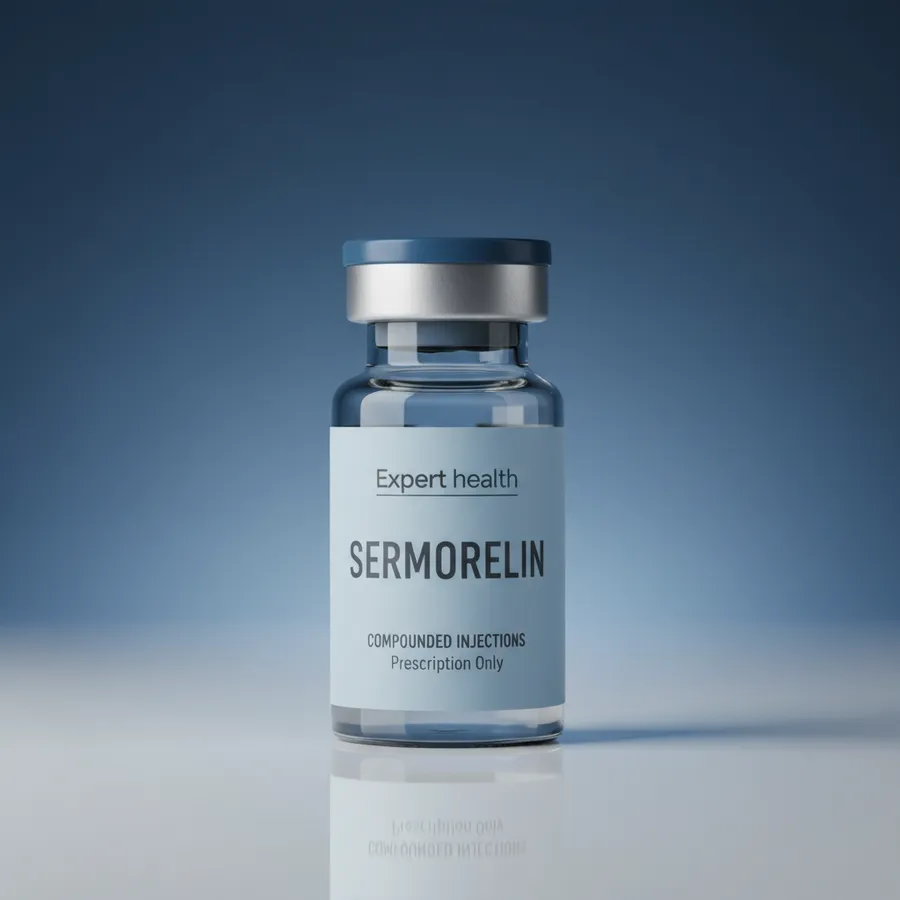
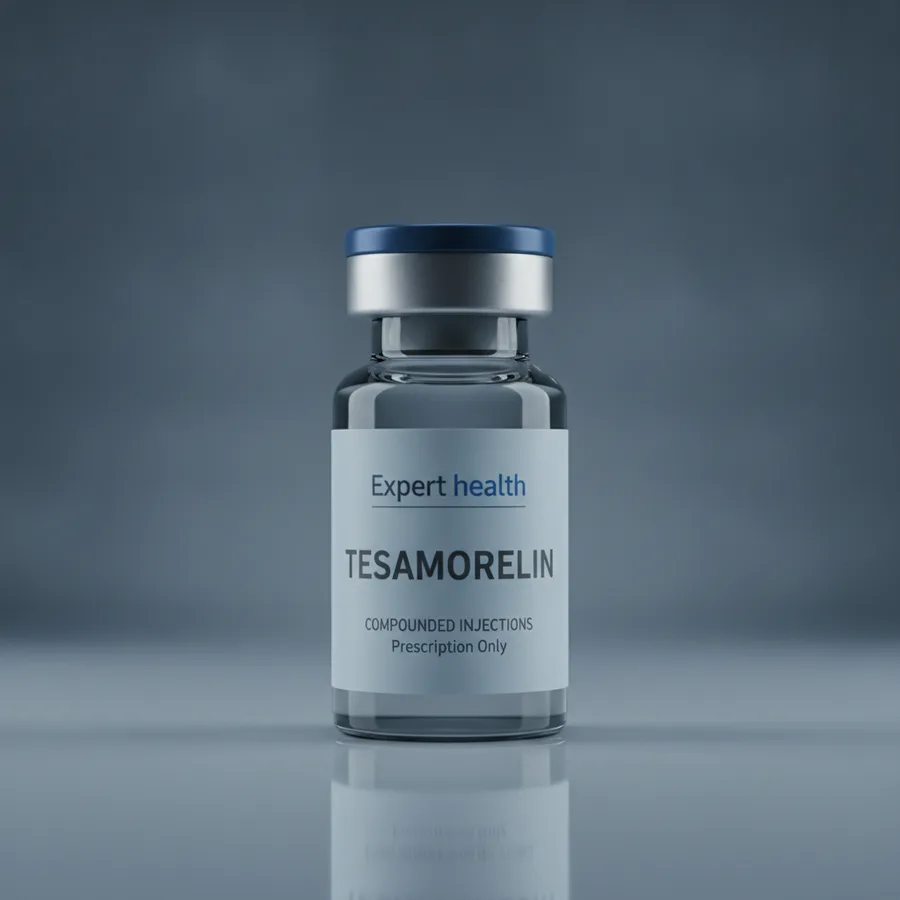
Product images are for illustrative purposes only. Actual medication vials, packaging, pharmacy labels and branding may vary. Expert Health facilitates access to care but does not compound, manufacture or dispense prescription medications. Medications are fulfilled by independent licensed pharmacies where legally permitted.
Start with Sermorelin.
As low as $199/mo. Prescribed by a US-licensed provider, compounded by a licensed US pharmacy, and shipped free to your door.
See Sermorelin and pricingNot sure it is the right fit? Speak with a health specialist, free, or browse all treatments.