Sermorelin vs HGH: what is the difference?
Sermorelin is a growth-hormone-releasing hormone analogue: it signals your own pituitary to release growth hormone in its natural pulses. HGH (somatropin) is recombinant growth hormone injected directly, which bypasses that signal. The other difference is legal. Federal law limits human growth hormone to FDA-authorized medical conditions, so it cannot be prescribed for anti-aging or athletic use. Sermorelin is prescription only and compounded.
How each one works
Your pituitary gland releases growth hormone in bursts, mostly at night, in response to a signal from the hypothalamus called growth-hormone-releasing hormone. Sermorelin is a synthetic analogue of that signal. It acts one step upstream, asking the pituitary to do its own job, which means the release still passes through your body's normal feedback control.
HGH is the hormone itself, made recombinantly and injected. There is no upstream signal and no pulse to speak of, because the medication is the hormone. That is why it is used to treat diagnosed growth hormone deficiency and a small number of other approved conditions, and why it needs careful supervision.
| Sermorelin | HGH (somatropin) | |
|---|---|---|
| What it is | A synthetic analogue of growth-hormone-releasing hormone | Recombinant human growth hormone, the hormone itself |
| How it acts | Signals your pituitary to release your own growth hormone | Replaces or adds growth hormone directly |
| Feedback control | Release still passes through your body's own regulation | Bypasses that regulation, so levels are set by the dose |
| FDA status | No FDA-approved product on the US market, prescribed and compounded | FDA-approved for specific diagnosed conditions only |
| Legal to prescribe for anti-aging or sport | Not approved for it, prescribed at a provider's discretion | No. Federal law restricts it to FDA-authorized medical conditions |
| Typical cost | $199 per month at Expert Health | Commonly several hundred to a few thousand dollars per month |
| Monitoring | Provider review, with IGF-1 and glucose checks where indicated | Close specialist monitoring, including IGF-1 and glucose |
Compounded medications are not FDA-approved. This table describes mechanism, regulation, and cost. It is not a claim that either medication will produce a result for you.
Is HGH legal, and is sermorelin legal?
This is the part most comparisons get wrong, so it is worth being exact. Human growth hormone sits under a specific federal restriction. It is a crime to distribute human growth hormone, or to possess it with intent to distribute, for any use in humans other than the treatment of a disease or other recognized medical condition that the FDA has authorized, and then only on a physician's order. The FDA has treated writing a prescription as distribution for this purpose.
In practice that means HGH is legally available for diagnosed conditions such as growth hormone deficiency, and it cannot legally be prescribed in the United States for anti-aging, bodybuilding, athletic performance, or general wellness. Clinics that offer it for those reasons are not operating within the law. Federal prosecutors have brought cases on exactly this point.
Sermorelin is a different molecule and is not human growth hormone, so that statute does not apply to it. It is a prescription medication with no FDA-approved product currently marketed in the US, which is why it is prepared by a compounding pharmacy on a prescription. Compounded medications are not FDA-approved, and sermorelin has no FDA-approved use for the goals people usually search for. A US-licensed provider decides whether prescribing it is reasonable for you.
This is a general description of how these medications are regulated, not legal advice. Both are also prohibited in competitive sport under the World Anti-Doping Agency list, so if you are a tested athlete, neither is an option.
Safety and monitoring: what is different
The usual argument for sermorelin is mechanistic rather than proven: because it prompts your own pituitary rather than replacing the hormone, the release remains subject to your body's feedback control, which reviewers have suggested may reduce the chance of the supraphysiologic levels associated with direct growth hormone dosing. That is a reasonable rationale. It is not the same as a head-to-head trial showing sermorelin is safer, and no such trial exists.
- What is monitored. Providers typically look at IGF-1 and blood glucose where indicated, plus how you actually feel, rather than dosing to a number alone.
- Common complaints on sermorelin. Injection-site reactions, flushing, and headache are the ones usually reported, and they are usually mild.
- Who should not take it. Active cancer, pregnancy or breastfeeding, and certain pituitary conditions are reasons a provider will say no. Tell them your full history, including family cancer history.
- Growth hormone itself. Direct HGH carries a well-documented set of risks, including fluid retention, joint pain, and effects on blood sugar, which is part of why it is supervised so tightly.
What the evidence actually shows
Be careful with any page that answers this confidently. Growth-hormone-releasing hormone analogues clearly do what they say mechanistically: they raise growth hormone release and IGF-1. What is much thinner is the long-term clinical outcome data in healthy adults taking sermorelin for energy, body composition, or aging. Reviews of growth hormone secretagogues describe the class as generally well tolerated in the studies available while calling for longer, larger safety and outcome trials.
The honest summary is that this is an early evidence base built on small studies, and nobody can tell you what it will do for you. See the science of sermorelin for the studies themselves, and how long sermorelin takes to work for what people typically report.
Which one is actually available to you
For most people asking this question, HGH is not on the table at all, because the reason they are asking is not an FDA-authorized medical condition. If you think you may have diagnosed growth hormone deficiency, that is an endocrinology conversation, not a telehealth purchase. If you are exploring growth-hormone support more generally, sermorelin is the prescription option a licensed provider can consider.
- A free call with a health specialist, with no obligation to buy
- An honest answer, including when the answer is that this is not right for you
- Sermorelin at $199 per month, or $597 for about a 10-week supply, if it is appropriate
- Compounded by a licensed US pharmacy, shipped free, with provider check-ins
Expert Health does not sell HGH. Compounded medications are not FDA-approved, and sermorelin is not FDA-approved for anti-aging, muscle, or weight goals.
Frequently asked questions
What is the difference between sermorelin and HGH?
Is sermorelin safer than HGH?
Can a doctor legally prescribe HGH for anti-aging?
Is sermorelin FDA approved?
Does sermorelin raise IGF-1 like HGH does?
Is sermorelin cheaper than HGH?
Are sermorelin and HGH banned in sport?
Can I take sermorelin and HGH together?
Sources
- The Safety and Efficacy of Growth Hormone Secretagogues (Sigalos & Pastuszak) · US National Library of Medicine, PubMed Central
- Norditropin (somatropin) injection, prescribing information · US Food and Drug Administration
Content is provided for educational purposes only and does not constitute medical advice. Mention of a medication or substance does not indicate that it is available through Expert Health. Treatment availability and eligibility are determined by licensed healthcare professionals and applicable regulations. This article is for general educational purposes and is not medical or legal advice. Statements have not been evaluated by the FDA, and treatments referenced are not intended to diagnose, treat, cure, or prevent any disease. Compounded medications are not FDA-approved. Individual results vary. Always consult a licensed provider before starting any treatment.
Explore growth-hormone & testosterone treatments
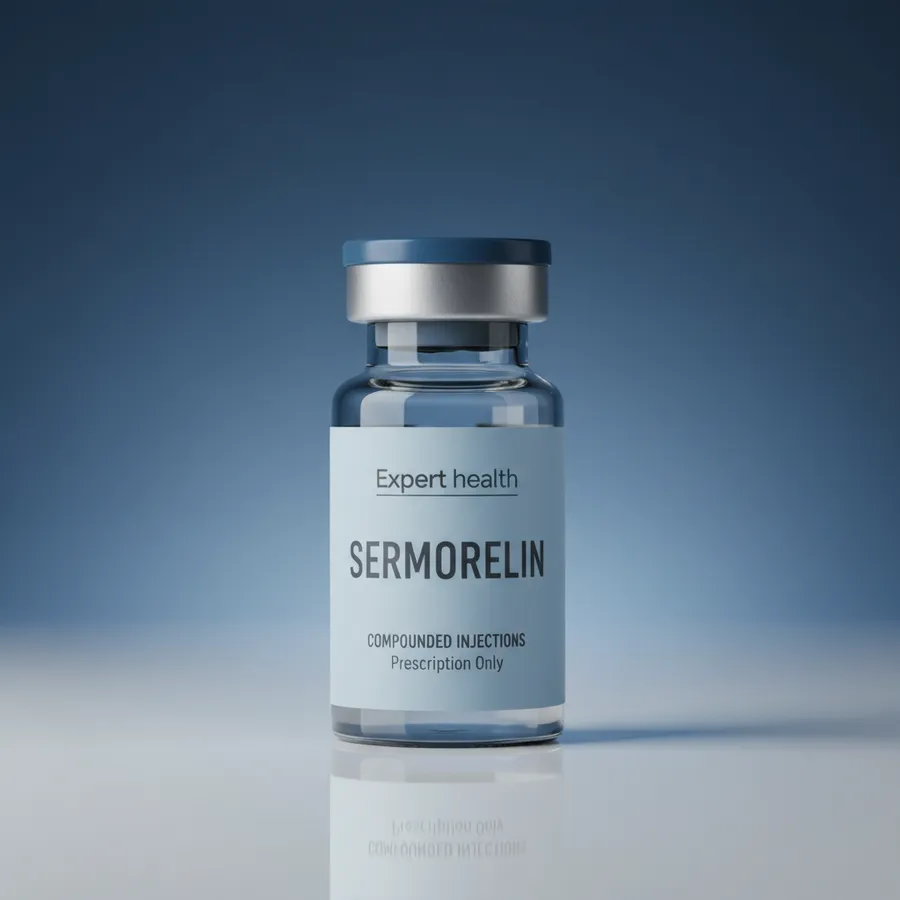
Product images are for illustrative purposes only. Actual medication vials, packaging, pharmacy labels and branding may vary. Expert Health facilitates access to care but does not compound, manufacture or dispense prescription medications. Medications are fulfilled by independent licensed pharmacies where legally permitted.
Start with Sermorelin.
As low as $199/mo. Prescribed by a US-licensed provider, compounded by a licensed US pharmacy, and shipped free to your door.
See Sermorelin and pricingNot sure it is the right fit? Speak with a health specialist, free, or browse all treatments.