How long does sermorelin take to work?
There is no established timeline, and anyone quoting you one is guessing. Sermorelin acts on the pituitary within hours of a dose, but what people most often report noticing first is sleep quality, over the first several weeks. Changes in body composition are reported much later, over several months, if at all. The evidence base is early, and individual response varies widely.
What happens in your body, and when
Sermorelin is an analogue of growth-hormone-releasing hormone. Injected at night, it signals the pituitary to release growth hormone, which is when your largest natural pulse happens anyway. That signalling effect is fast, within hours of the dose. Your liver then responds to circulating growth hormone by producing IGF-1, which rises over days to weeks and is what providers measure.
None of that is the same as feeling different. The gap between a measurable hormonal change and a change you notice is where most of the confusion about timelines lives, and it is why honest answers to this question are vaguer than marketing ones.
The timeline people typically report
The table below is what patients commonly describe and what providers commonly plan around. It is not a schedule of results, and it is not drawn from a trial in healthy adults, because that trial does not exist in the form people want.
| Timeframe | What is typically reported | What is actually happening |
|---|---|---|
| First week | Usually nothing noticeable. Some people report vivid dreams or feeling more soundly asleep | Nightly signalling begins, IGF-1 starting to shift |
| Weeks 2 to 6 | Sleep quality is the most commonly reported early change, sometimes daytime energy | IGF-1 typically settling into a new range, which a provider can check |
| Months 2 to 3 | Some people report changes in sleep or daytime energy | The point at which most providers do a meaningful review |
| Months 3 to 6 | Body composition changes, where they are reported at all, are described here rather than earlier | The longest most people stay on a first course before reassessing |
| After stopping | Reported changes generally fade, since the signal has stopped | Growth hormone release returns to your own baseline |
These are commonly reported patterns, not promised outcomes. Individual response varies widely, some people report nothing at all, and the human evidence for sermorelin in healthy adults is early and comes from small studies.
Why response varies so much
Sermorelin asks your pituitary to do something. How much it does depends on you, which is the honest reason two people on the same dose can have completely different experiences:
- Your baseline. If your own growth hormone output is already healthy, there is less room for an upstream nudge to change anything.
- Age. Growth hormone release declines with age, which is why interest in this class rises after 40.
- Sleep. The dose is designed to work with your nocturnal pulse. Poor or short sleep undercuts the whole premise.
- Consistency. This is a nightly medication. Missed doses are the most common reason a course goes nowhere.
- Timing and food. Providers usually advise dosing at night, away from a large meal, for the same reason.
- Everything else. Training, protein intake, alcohol, and stress all move the same outcomes people are attributing to the peptide.
What the evidence does and does not show
Mechanistically, growth-hormone-releasing hormone analogues do what they claim: they increase growth hormone release and raise IGF-1. That part is not controversial. What is thin is the long-term outcome data in healthy adults using sermorelin for energy, recovery, body composition, or aging. The studies are small, often short, and reviews of the growth hormone secretagogue class describe them as generally well tolerated while explicitly calling for larger and longer trials.
We are not going to tell you a percentage of people who respond, or how much of anything you will gain or lose, because the data to support that does not exist for this population. If a clinic quotes you numbers for sermorelin in healthy adults, ask which trial they came from.
Sermorelin is not FDA-approved for anti-aging, muscle, weight, or energy. Compounded medications are not FDA-approved. A US-licensed provider decides whether it is reasonable to try in your case.
How progress is tracked at Expert Health
Because the honest expectation is uncertain, the plan is built around checking rather than assuming:
- A free call with a health specialist before anything is prescribed
- Baseline labs where your provider thinks they are useful, including IGF-1
- Sermorelin at $199 per month, or $597 for about a 10-week supply, if it is appropriate
- Provider check-ins to review sleep, energy, recovery, and how you are tolerating it
- A real conversation about stopping if nothing is happening after a fair trial
A course that is not doing anything for you is not a course worth paying for. That is a normal outcome to discuss with your provider, not a failure.
When to reassess
- Give it a fair trial. Most providers will not judge a course before two to three months of consistent nightly dosing.
- Track something specific. Sleep quality and morning energy are easier to judge honestly than a vague sense of wellbeing.
- Re-check labs if your provider ordered them at baseline, so the review is not purely subjective.
- Stop and reconsider if there is nothing to show after a full course. Spending more months on it in hope is not a plan.
- Raise anything unusual straight away, particularly swelling, joint pain, numbness or tingling, or changes in blood sugar.
For prices see sermorelin cost, for the studies see the science of sermorelin, and if you are weighing the alternatives see sermorelin vs tesamorelin.
Frequently asked questions
How long does sermorelin take to work?
How soon will I notice better sleep?
How long should I stay on sermorelin before deciding?
Do the effects go away if I stop?
Why do some people notice nothing at all?
Does sermorelin work faster at a higher dose?
Should I get labs before starting?
Sources
- The Safety and Efficacy of Growth Hormone Secretagogues (Sigalos & Pastuszak) · US National Library of Medicine, PubMed Central
Content is provided for educational purposes only and does not constitute medical advice. Mention of a medication or substance does not indicate that it is available through Expert Health. Treatment availability and eligibility are determined by licensed healthcare professionals and applicable regulations. This article is for general educational purposes and is not medical or legal advice. Statements have not been evaluated by the FDA, and treatments referenced are not intended to diagnose, treat, cure, or prevent any disease. Compounded medications are not FDA-approved. Individual results vary. Always consult a licensed provider before starting any treatment.
Explore growth-hormone & testosterone treatments
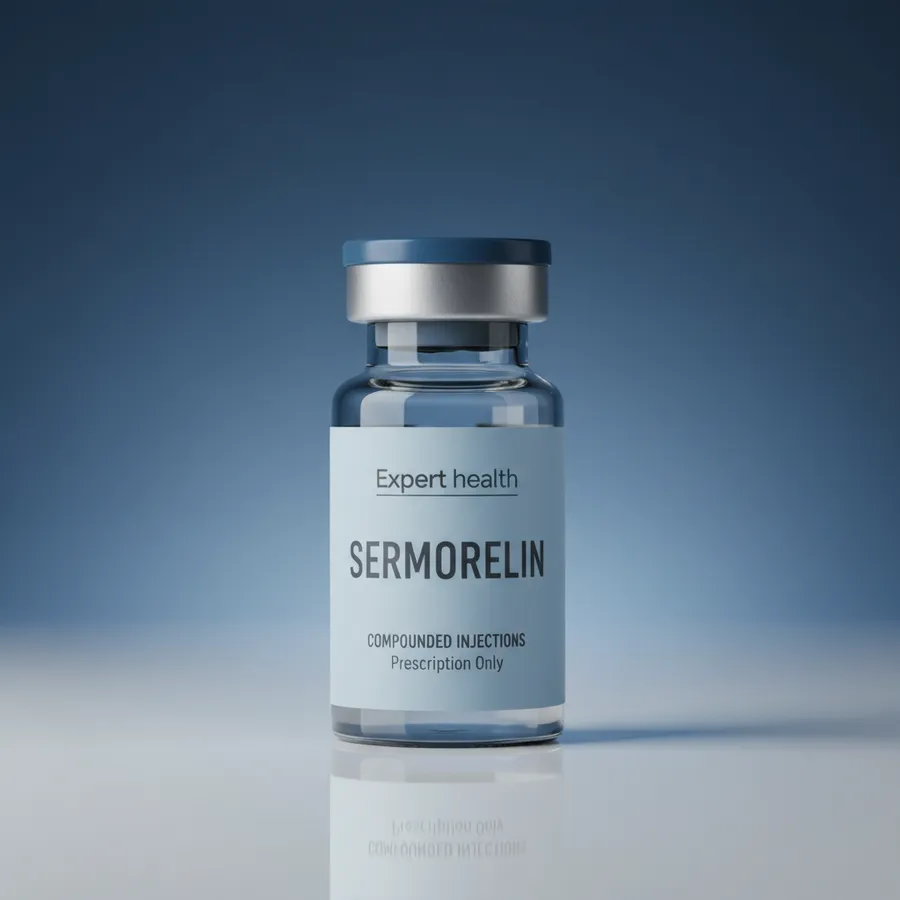
Product images are for illustrative purposes only. Actual medication vials, packaging, pharmacy labels and branding may vary. Expert Health facilitates access to care but does not compound, manufacture or dispense prescription medications. Medications are fulfilled by independent licensed pharmacies where legally permitted.
Start with Sermorelin.
As low as $199/mo. Prescribed by a US-licensed provider, compounded by a licensed US pharmacy, and shipped free to your door.
See Sermorelin and pricingNot sure it is the right fit? Speak with a health specialist, free, or browse all treatments.