Why is it so hard to lose weight after 40?
Because the same effort genuinely produces less result than it used to. From your late thirties onward, estrogen begins to fluctuate and then fall, lean muscle declines gradually with age, sleep is more often broken, and insulin sensitivity tends to drop. Those changes stack. You are not imagining it and you have not failed. What has to change is the approach, not the effort.
Is it actually harder, or does it just feel harder?
It is actually harder. The most common thing women in their forties describe is doing exactly what worked at thirty and watching it do nothing, then quietly concluding that the problem is them. It is not. Several ordinary, well documented changes of midlife happen to push in the same direction at the same time, and each one on its own is small enough to dismiss.
It is worth separating two things that get blurred together. Body weight tends to creep up with age in men and women alike, largely from lower muscle mass and less movement. What is specific to women in this decade is the hormonal transition, which changes where fat is stored and how well you sleep, on top of the age effect. Both are real, and they are not the same problem.
| What changes after 40 | Why it affects your weight | What you can influence |
|---|---|---|
| Estrogen fluctuates, then falls | Fat storage shifts from hips and thighs toward the abdomen, and appetite and mood signals get less predictable | Not the hormone itself, but sleep, strength training, and what you eat around it |
| Lean muscle declines with age | Muscle is metabolically active tissue, so less of it means your body uses less energy at rest | A lot. Resistance training and protein intake are the most reliable levers you have |
| Sleep gets broken | Short or fragmented sleep raises appetite, lowers satiety, and makes the next day's decisions harder | Often more than you would expect, and night sweats or insomnia are worth raising clinically |
| Insulin sensitivity tends to drop | Your body handles carbohydrate less efficiently, which is also why abdominal fat becomes more likely | Movement after meals, protein and fiber, muscle mass, and sleep all feed into this |
| Stress and load peak in this decade | Cortisol, less time, and less recovery are not an excuse, they are a genuine physiological input | Realistic planning beats heroic planning, because consistency is the thing that pays |
| Repeated dieting adds up | Years of aggressive restriction tend to cost lean mass, which quietly lowers the baseline you are working from | Stop restricting harder. Rebuilding muscle is the corrective, not another deficit |
General orientation, not medical advice. How much each factor applies to you is a clinical question, and some of these overlap with conditions that need testing rather than effort.
Why the thing that used to work has stopped working
The classic response is to do more of what worked before: eat less, run more, be stricter. In your forties that combination often makes the underlying problem worse, because the two things it costs you most are the two things you can least afford to lose, muscle and sleep.
- Cutting calories harder lowers your baseline. Aggressive restriction without enough protein or resistance training takes lean mass with it, and lean mass is part of what determines how much energy you use at rest.
- Cardio alone does not defend muscle. It is good for your heart and your head. It is not a substitute for giving muscle a reason to stay.
- Under-eating protein is easy and invisible. Most women who track honestly for a week find they are eating far less than they assumed, particularly at breakfast.
- Poor sleep undoes good intentions. If you are waking at three every morning, willpower at four in the afternoon is not the variable that is failing.
- Weekly weigh-ins mislead in perimenopause. Fluid shifts across an irregular cycle can swamp real change, which makes it very easy to quit something that was working.
None of this is a character problem. The willpower framing fails most people for reasons that are biological rather than moral, which is the argument made in full on is using a GLP-1 cheating.
What actually helps in this decade
The interventions that hold up are unglamorous and they are not new. What is different after 40 is the ranking. Strength and protein move up, restriction moves down.
Worth your effort
- Resistance training two or three times a week, progressive and regular. This is the single highest-value change most women in their forties are not making.
- Enough protein, spread across the day, starting with breakfast. Many clinicians aim for roughly 1.0 to 1.5 grams per kilogram of body weight per day during active weight loss, and your provider should set your target, particularly with kidney disease.
- Protecting sleep as a medical priority, and treating what is wrecking it, including night sweats, restless legs, and snoring or suspected sleep apnea.
- Walking, and specifically walking after meals, which is easy to sustain and helps how your body handles a meal.
- Getting bloodwork rather than guessing, because thyroid, iron, and glucose are testable and effort is not a substitute for a diagnosis.
- A pace of loss you can hold for a year, since the goal is what you keep, not what the scale says in six weeks.
Not worth your money or your morale
- Another aggressive deficit on top of a decade of aggressive deficits.
- Supplements sold as menopause metabolism boosters or hormone balancers. The marketing consistently runs ahead of the evidence.
- Detoxes, cleanses, and anything promising to reset your hormones.
- Cardio as the whole plan, at the expense of strength work.
- Daily weighing as the only measure of progress, particularly with an irregular cycle.
- Assuming every symptom is menopause. Fatigue, weight change and low mood are common to several treatable conditions.
Where a prescribed option fits, and where it does not
A GLP-1 medication such as semaglutide or tirzepatide changes appetite regulation, so eating less stops requiring constant negotiation with yourself. For women whose main obstacle is that hunger and food preoccupation override every plan they make, that is the specific thing it addresses. It does not build muscle, fix your sleep, or treat menopause, and it is not appropriate for everyone.
Whether you are a candidate depends on your health history and measurements, not on how frustrated you are. See who qualifies for a GLP-1 for the criteria a provider actually uses, and semaglutide for women for the women-specific considerations before starting.
- A free consultation with a health specialist, with no obligation to buy
- A US-licensed provider reviews your history and decides whether treatment is appropriate, including declining if it is not
- Compounded semaglutide from $199 per month ($597 for a 3-month supply) or compounded tirzepatide from $332 per month ($997 for a 3-month supply), if you are prescribed one
- Provider check-ins every four weeks, so dose, tolerability and protein intake are reviewed rather than assumed
- Free, discreet shipping, and the price shown before you pay
Compounded medications are not FDA-approved, meaning the FDA has not reviewed them for safety, effectiveness, or quality before they are dispensed. Medication is one part of a plan, not the plan.
The part nobody tells women: muscle and bone
If you lose weight in this decade, the question is not only how much comes off but what comes off. Any rapid weight loss, by any method, takes some lean tissue with it, and bone density also tends to decline around and after menopause. Losing weight in a way that costs you muscle and bone is a bad trade at 45 in a way it was not at 25.
- Protein and resistance training are the defense, whether or not medication is involved. This is the same answer as for men, it simply matters sooner and more.
- Pace is a lever. Faster is not better, and a provider can hold or slow a dose if you are losing quicker than is comfortable.
- Ask about bone health. Calcium, vitamin D, weight-bearing exercise and, where appropriate, bone density screening are worth raising with your own clinician, especially if you have other risk factors.
- Strength is the outcome that ages well. Getting up from the floor, carrying shopping, and stairs are better long-term measures than a number on a scale.
The full picture on lean mass, including what does and does not protect it, is on do GLP-1s make you lose muscle. For what to put on the plate, see what to eat on a GLP-1.
When it is not just age: what to rule out
Fatigue, weight change, low mood and brain fog are the symptoms of the midlife transition, and they are also the symptoms of several conditions that are entirely treatable once identified. Assuming it is all hormones is the most common way a treatable problem goes unnoticed for years.
- Thyroid disease, which is more common in women and easily tested.
- Iron deficiency and anemia, particularly with the heavy or erratic periods that are common in perimenopause.
- Insulin resistance, prediabetes and type 2 diabetes.
- Polycystic ovary syndrome, which does not disappear with age and is often diagnosed late.
- Sleep apnea, which is under-diagnosed in women because the presentation is often fatigue rather than loud snoring.
- Depression and anxiety, which overlap heavily with these symptoms in both directions.
- Medications you already take, since several common ones affect weight.
Perimenopause is not a diagnosis you should hand yourself off a symptom list, and it is not a diagnosis we can hand you from a web page either. Take this list to a clinician who can order the relevant tests. For what the transition itself looks like, see perimenopause symptoms.
Frequently asked questions
Why is it so hard to lose weight after 40 as a woman?
Does menopause make you gain weight, or is it just getting older?
What is the best exercise for women over 40 trying to lose weight?
How much protein should a woman over 40 eat to lose weight?
Do weight loss medications work for women over 40?
Can perimenopause cause weight gain even if nothing else has changed?
Should I eat less to lose weight after 40?
What blood tests should I ask for if I cannot lose weight?
Content is provided for educational purposes only and does not constitute medical advice. Mention of a medication or substance does not indicate that it is available through Expert Health. Treatment availability and eligibility are determined by licensed healthcare professionals and applicable regulations. This article is for general educational purposes and is not medical or legal advice. Statements have not been evaluated by the FDA, and treatments referenced are not intended to diagnose, treat, cure, or prevent any disease. Compounded medications are not FDA-approved. Individual results vary. Always consult a licensed provider before starting any treatment.
Explore weight-loss treatments

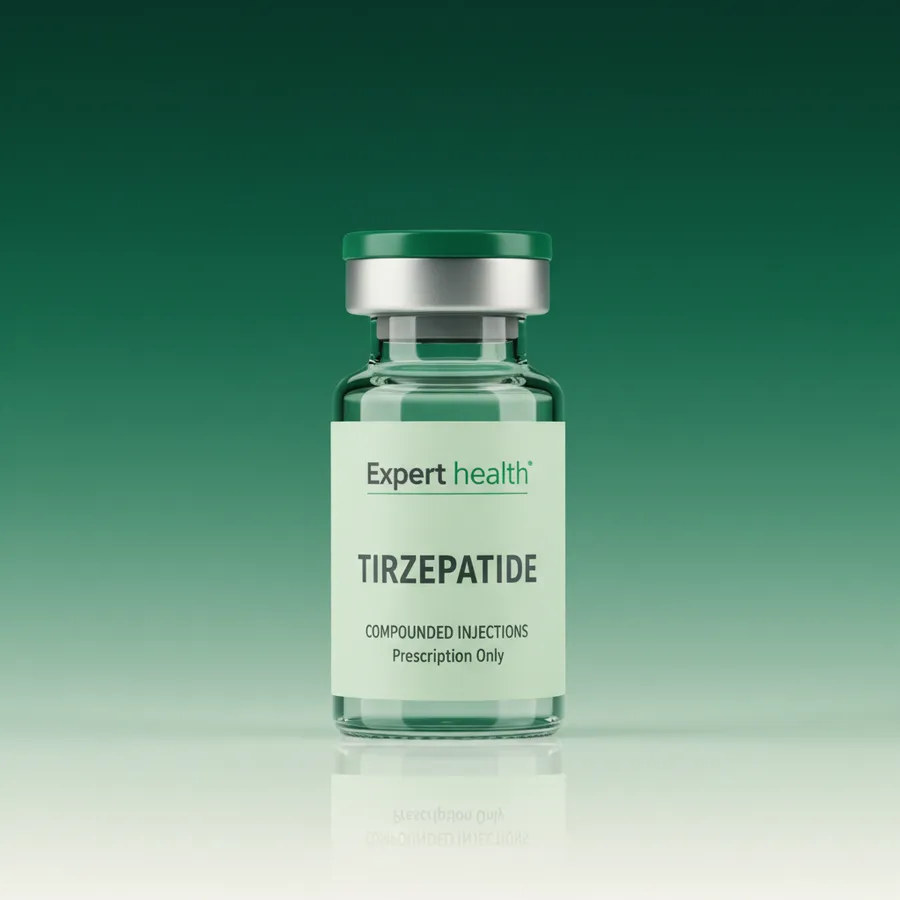
Product images are for illustrative purposes only. Actual medication vials, packaging, pharmacy labels and branding may vary. Expert Health facilitates access to care but does not compound, manufacture or dispense prescription medications. Medications are fulfilled by independent licensed pharmacies where legally permitted.
Start with Semaglutide.
As low as $199/mo. Prescribed by a US-licensed provider, compounded by a licensed US pharmacy, and shipped free to your door.
See Semaglutide and pricingNot sure it is the right fit? Speak with a health specialist, free, or browse all treatments.